
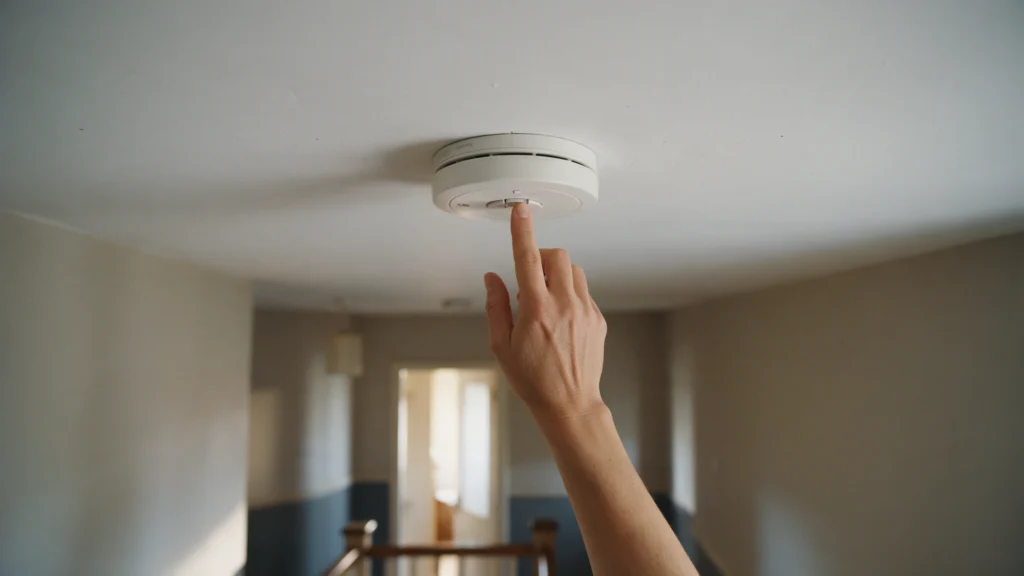
A smoke alarm that gives a single chirp every 30 to 60 seconds usually has a low battery. Change the battery, or replace the whole alarm if it is a sealed ten-year model, then press the test button. Never take the battery out just to stop the noise.
What the beep means
A short beep or chirp every so often, rather than a full alarm, means the alarm needs attention. Electrical Safety First says it could mean the battery is low or the sensor has a fault, and that you should never ignore it. The patterns below are the common ones. They differ a little between makes, so check the leaflet or the label on the back of the alarm.
| What you hear | It usually means | What to do |
|---|---|---|
| One chirp every 30 to 60 seconds | The battery is low | Replace the battery, then press the test button. |
| A sealed ten-year alarm chirping | The battery or the alarm has reached the end of its life | The battery cannot be changed. Check the replace-by date on the alarm and replace the whole alarm. |
| Still chirping after a new battery | A fault, or the alarm is past its replace-by date | Replace the alarm. |
| A mains alarm chirping | The back-up battery is low | Change it as the maker’s instructions say. Fitting or rewiring a mains alarm is a job for a qualified electrician. |
| A full alarm when you are cooking or showering | Steam or cooking smoke, often because the alarm is too close to the kitchen or bathroom | Open a window and waft the air near the alarm. Do not take the battery out. If it keeps happening, move the alarm or fit a heat alarm in the kitchen. |
Get KITHELD when it launches. It’s the app we’re building to record what your household has, where it’s kept and when it goes out of date.
We'll email you when KITHELD is available. In the meantime, our guide to storing water might be useful.
How much water to storeHow to stop the beeping safely
- With a replaceable battery, government guidance says that if a smoke alarm starts to beep regularly, you should replace the battery straight away. Then press the test button to check it works.
- With a sealed ten-year alarm, you cannot change the battery. Look for the replacement date on the alarm, because ten-year alarms need replacing as a whole every ten years. If it is near that date, or it keeps beeping, replace it.
- Many alarms let you silence a low-battery chirp for a few hours by pressing the test button, and they still detect smoke while silenced. Buckinghamshire Fire and Rescue Service advises replacing a low-battery alarm right away, and within seven days at most, because it may not have enough power to warn you of a real fire after that. If an alarm cannot be silenced at all, treat it as faulty and replace it.
Whatever the type, do not take the battery out to stop the noise. Government guidance says to take the battery out only when you are replacing it. The Fire Kills campaign, run by the government with the National Fire Chiefs Council (NFCC), also says never to disconnect an alarm or take its batteries out if it goes off by mistake.
If steam or smoke from cooking keeps setting an alarm off, it may be too close to the kitchen. Guidance says not to fit smoke alarms in or near kitchens or bathrooms. Heat alarms are designed to detect fires in kitchens, where smoke alarms should not go.
How often to test
Government fire safety guidance, Fire safety in the home, says to test smoke alarms at least monthly. The Be Ready website gives the practical version: set a reminder in your phone or make a note on your calendar to check them at least once a month.
How to test a smoke alarm
Press and hold the test button until the alarm sounds. Government guidance says this tests the smoke sensor as well as the battery or power supply.
If the alarm is quiet or makes no sound at all:
- if it has a replaceable battery, change the battery and test it again;
- if it is a sealed ten-year alarm, the battery cannot be changed, so replace the whole alarm;
- if it still does not sound after a new battery, replace the alarm.
Test every alarm in the home, including mains-powered ones, which need testing just like battery alarms. The same guidance suggests vacuuming alarms every six months to clear dust.
The same guidance says ten-year sealed battery alarms are the best option. Standard battery alarms are cheaper, but their batteries need replacing every year.
Check you have enough alarms
While you are testing, count them. Government guidance for England recommends at least one smoke alarm on every level of your home, fitted on the ceiling, ideally in hallways and landings.
In Scotland the rules are stricter. Every home must now have interlinked alarms: a smoke alarm in the living room or the room you use most, one in every hallway and landing, and a heat alarm in the kitchen. Interlinked means that if one goes off, they all go off.
In Wales and Northern Ireland, your local fire and rescue service can tell you what it recommends.
Set the reminder now
The test takes seconds, but it is easy to forget. While you are thinking about it:
- Open the calendar or reminders app on your phone.
- Create a reminder called “Test smoke alarms”.
- Set it to repeat monthly, on a day that is easy to remember, such as the first of the month.
- If someone else at home is often the one who is around, add it to their phone too.
Once a year, use the same reminder to check whether any battery alarms need new batteries, and look at the date on sealed alarms to see when they are due for replacement.
If you need help
If it is difficult for you to fit or reach smoke alarms yourself, contact your local fire and rescue service. Government guidance says they can help install them.
Alarms with a strobe light or vibrating pad are available for people who are deaf or hard of hearing. Your fire and rescue service can advise on these too.
And if an alarm ever does go off because of a real fire, get everyone out and call 999. Do not stop to collect belongings.
Smoke alarms are one of several small, regular checks worth building into the year. The government’s new Be Ready advice includes monthly smoke alarm tests, and our UK emergency kit checklist covers the rest.
Updated 27 October 2026 for the government’s new Be Ready advice.
Sources checked 12 October 2026, chirp patterns checked 24 October 2026: GOV.UK: Fire safety in the home; Be Ready: be ready for emergencies; Scottish Government: fire and smoke alarms in Scottish homes; NFCC: Fire Kills campaign; NFCC: Fire Kills briefing pack, October 2026, smoke alarm testing; Electrical Safety First: The BEEP; Buckinghamshire Fire and Rescue Service: faulty smoke alarms; Kidde: what causes consistent chirping.
 What to do in a power cut, and what to have ready
 What to put in an emergency kit in the UK
 Start with what you already own: a ten-minute household check
 Where is my stopcock? How to find your stop tap and turn off water, gas and electricity