
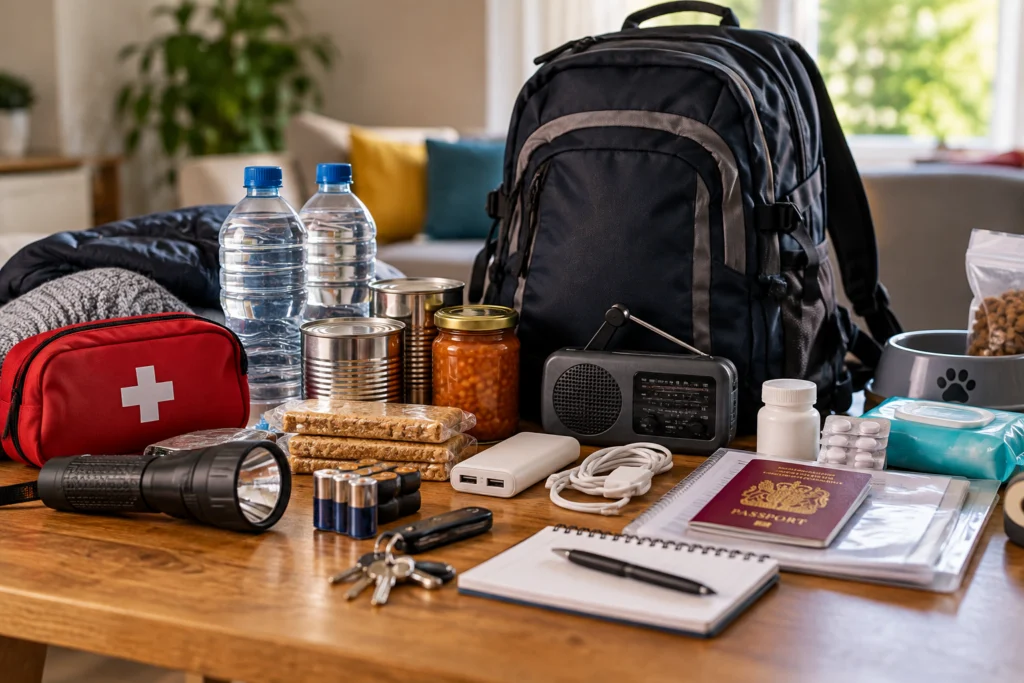
A household emergency kit is a small collection of ordinary things that help you cope if the power goes out, the water stops, you are asked to stay at home or you need to leave quickly. You do not need specialist survival gear.
Current UK Government guidance encourages households to think about emergencies lasting a few days and to keep useful supplies somewhere easy to find. What goes in your kit depends on the people, pets and medical needs in your home.
This list follows the emergency kit list on the government’s Be Ready website. It is our version, not an official list, and the Government has not endorsed KITHELD. Advice and services vary across the UK, so households in Wales, Scotland and Northern Ireland should also follow guidance from their own national and local authorities. For how much of each to keep and where to store it, see our guide to what to put in an emergency kit.
The essentials to keep at home
Be Ready suggests keeping basic emergency supplies like these at home.
- A battery or wind-up torch, plus spare batteries.
- A charged portable power bank for mobile phones.
- A battery or wind-up radio so you can still receive updates during a power cut.
- A basic first aid kit.
- Hand sanitiser and wet wipes in case the water supply is interrupted.
- Non-perishable food that can be eaten without cooking, plus a tin opener where needed.
- Bottled water.
- Any essential medication your household relies on.
Torches are safer than candles because they are not a fire risk. A radio is useful if mobile networks, home internet or local power supplies are disrupted.
To see how much of each your home needs, use our UK emergency kit checklist for your household.
Get KITHELD when it launches. It’s the app we’re building to record what your household has, where it’s kept and when it goes out of date.
We'll email you when KITHELD is available. In the meantime, our guide to storing water might be useful.
How much water to storeHow much water should you keep?
Be Ready recommends 3 litres of drinking water per person per day, for 3 days. Around 10 litres per person per day gives more flexibility for basic cooking and hygiene. You may need more for baby formula, pets or medical equipment.
For longer-term storage, the government recommends commercially bottled water rather than containers filled with tap water and left indefinitely.
See the official water supply interruption guidance for more detail.
Make sure your kit works for your household
Families with babies may need ready-to-feed formula, nappies and other feeding supplies. Pet owners should include food, water and anything an animal would need if the household had to leave home.
If anyone relies on medication, medical devices or mobility equipment, you will need to plan further. Government guidance for disabled people and carers recommends keeping medication details and device instructions on paper, keeping backup batteries charged where possible, and making sure trusted people know what support may be needed.
If you may need extra help when your power, gas or water is cut off, check whether you can join your supplier’s Priority Services Register.
See Be Ready’s guidance for disabled people and carers.
Keep information on paper too
Write down important numbers and information in case your phone battery dies or you cannot get online. Be Ready recommends keeping details such as:
- family, friends and emergency contacts;
- the power-cut number: 105 in England, Scotland and Wales;
- regular medication;
- insurance policy details;
- useful local and national radio frequencies.
It is also worth agreeing a household meeting point in case people cannot get home or contact each other.
Home supplies and a grab bag
Some emergencies mean staying at home; others may mean leaving. Keep your main household supplies together somewhere easy to reach. Separately, it can help to keep a bag ready, sometimes called a grab bag, with the things you would need if the authorities asked you to evacuate.
That might include medication, chargers, important documents, spare clothing, essential items for children, and anything needed for pets or assistance animals.
If you are escaping a fire, do not stop to collect a bag or belongings. Leave immediately and follow fire service advice.
Steps that cost nothing
Check the risks where you live, sign up for relevant warnings, learn how to turn off your home’s water, gas and electricity if instructed, test smoke alarms regularly, and talk through what your household would do if you could not contact each other.
The government’s Be Ready website also has guidance on power cuts, flooding, extreme weather, emergency alerts and other hazards.
Updated 27 October 2026 for the government’s new Be Ready advice.
Sources: Be Ready: be ready for emergencies; Be Ready: water supply interruptions or outages; Be Ready: advice for disabled people and carers; Ready Scotland: emergency kit; nidirect: household emergency kit.
Sources last checked: 11 October 2026.
 What to put in an emergency kit in the UK
 How much water to store per person
 What to do in a power cut, and what to have ready
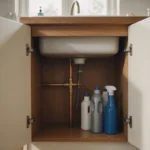 Where is my stopcock? How to find your stop tap and turn off water, gas and electricity