
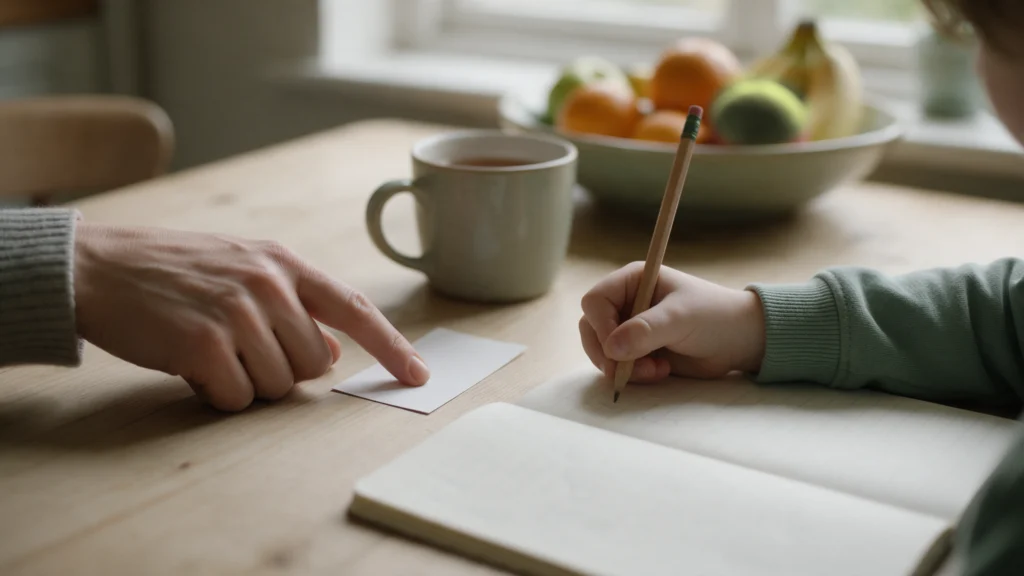
A useful bit of emergency preparation does not live in a cupboard. It is three things a child can carry in their head: when to call 999, their home address and a grown-up’s phone number. A few minutes of calm practice shows you what they already know and what needs another go.
The Be Ready website suggests talking to children about what to do in an emergency, including how and when to call the emergency services, and helping them learn their home address and, if possible, a parent or guardian’s mobile number. It also says to practise these regularly. This guide is about how to do that without making it frightening.
Keep it calm and ordinary
Children take their cue from the adults around them. Treat this like learning to cross the road: a normal skill, not a warning. Pick a quiet moment, at the kitchen table or on a car journey, rather than straight after a news story.
Keep the framing practical: “If a grown-up is hurt and can’t get up, or there’s a fire, this is what you do.” You do not need to describe what might go wrong. The aim is that they know the steps, not that they worry about them.
Get KITHELD when it launches. It’s the app we’re building to record what your household has, where it’s kept and when it goes out of date.
We'll email you when KITHELD is available. In the meantime, our guide to storing water might be useful.
How much water to store1. When to call 999
Be Ready’s own rule is simple: call 999 if you or someone else is in immediate danger. For a child, that might be: someone is badly hurt, someone will not wake up, there is a fire, or someone is in danger right now.
It helps to know what happens next. GOV.UK explains that the first person to answer says “emergency, which service?”, so practise the answer: police, fire or ambulance. Childline’s guide to calling 999, written for young people, explains that callers will be asked what has happened and where they are, and should stay on the line and follow the instructions they are given.
Two things worth adding:
- 999 is never for practice. Rehearse with a toy phone, a switched-off phone or simply by pretending, and explain that real calls are only for real emergencies.
- Show them how to call from a locked phone. Most smartphones have an emergency call option on the lock screen that works without the passcode. Show your child where it is on the phones at home.
2. Their home address
On a 999 call, being able to say where you are matters. Start with the house number and street name, then add the town and, when they are ready, the postcode.
A few ways to help it stick:
- say it out loud together as you walk up to the front door;
- turn it into a rhythm or a short song;
- ask them to spot the house number and the street sign;
- if they split time between two homes, practise one address at a time.
3. A grown-up’s phone number
Be Ready says to help children learn a parent or guardian’s mobile number “if possible”, and that is the right expectation. Eleven digits is a lot. Break the number into chunks, the way you would say it aloud, and practise one chunk at a time.
Check they know whose number it is and when they would use it: if they are lost, separated from you, or need a grown-up and you are not there.
Adjust it to their age
- Younger children: one thing at a time. Start with “999 is for when someone is badly hurt or in danger” and the name of your street. Role-play with a toy phone.
- Primary school age: the full address, the “which service?” question, and your mobile number in chunks.
- Older children and teenagers: the address with postcode, at least one number by heart, and how to make an emergency call from a locked phone.
Write it on a card as well
Memory can go blank under pressure, even for adults. So write your address and two grown-ups’ numbers on a small card too. Keep one at home somewhere easy to find, and, if it suits your family, one inside a school bag rather than on display. Be Ready gives similar advice for the whole household: keep important numbers on paper somewhere easy to find.
Little and often
One conversation is unlikely to stick. Short, casual check-ins work better: ask for the address on the way home, or the phone number while you wait for the bus. Praise what they get right and come back to the rest another day.
While you are thinking about it, check that your child’s school or childcare provider has your current contact numbers. Be Ready suggests this too, so they can reach you during an emergency.
The StayWise website, which Be Ready points to, has emergency safety resources aimed at children. For the rest of the household, our UK emergency kit checklist includes what to think about for children.
Updated 27 October 2026 for the government’s new Be Ready advice.
Sources checked 4 October 2026: Be Ready: be ready for emergencies; GOV.UK: 999 and 112, the UK’s national emergency numbers; Childline: calling 999; StayWise.
 What to put in an emergency kit in the UK
 Start with what you already own: a ten-minute household check
 Smoke alarm beeping or chirping? What it means and what to do
 Where is my stopcock? How to find your stop tap and turn off water, gas and electricity